Proverbs 16:32 He who is slow to anger is better than the mighty, And he who rules his spirit, than he who captures a city.
Do you ever feel grumpy on the inside and then struggle to name it? You’ve got to “name that emotion to tame it!” Or do you every wonder why you are feeling a certain way and then wonder what do you NEED to feel better? There is a need under every emotion.
Mark Bracket has a 4-quadrant mood meter that helps use our interoception to examine feelings on the inside and then use words to label feelings as emotions relative to a given situation. What if the situation was a flat tire in the pouring rain? Assess yourself right now, who would be in the red (high energy, unpleasant) like anxious or angry? High energy, pleasant (yellow) like elated? Low energy, unpleasant (blue) like deep sadness? And then Low energy, pleasant (green) like content or calm? Now, in 3 seconds, label the emotion you would feel. How many people would have trouble labeling the emotion with a word? Who had rules about emotions in their lives, expressing them or not like anger, not crying in public? Nature and nurture impact our emotion usage and literacy. When we become more emotionally literate, we can experience more positive emotions, decrease problem behavior, have better decision making, and learn better because they are regulated (per Brackett). The trick is that when you have a flat tire (for real or emotionally) then self-assess the internal sensations and wonder why.
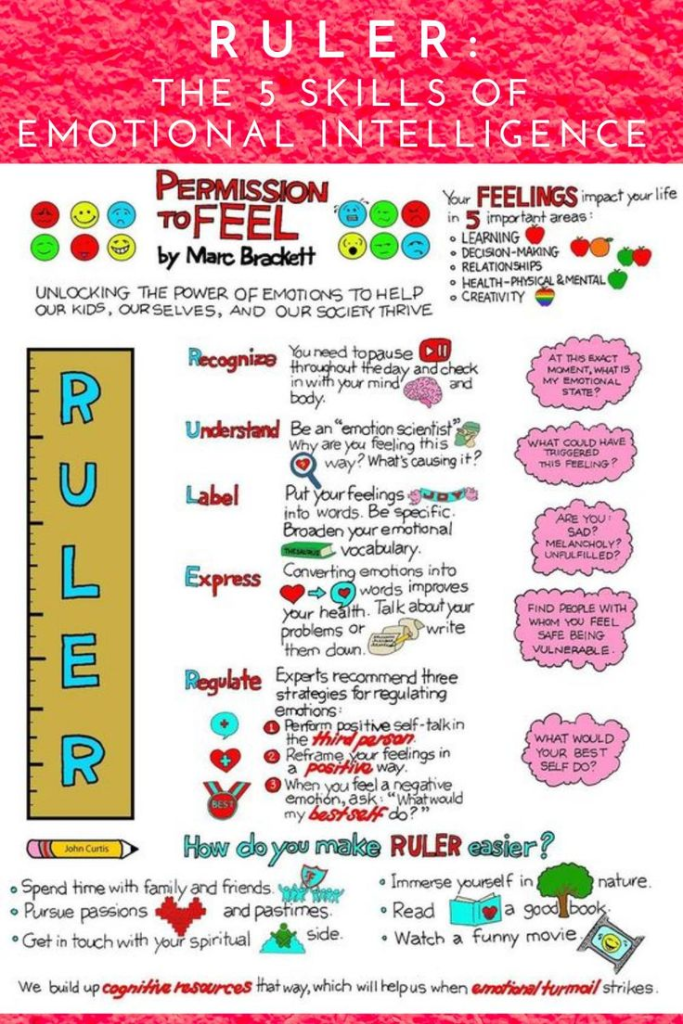
My meltdown: Situation: Flat tire. I had trouble regulating because I didn’t label my emotion in the process of trying to solve my problem in a situation. I should have used Brackett’s RULER method. I was nervous and my daughter was like “mom you’re shook and was frustrated.” She didn’t see I was concerned she would get home late and that my husband would be disappointed he was missing his “precious” basketball game to come change my tire. If I’d dug deeper and took a moment (if I had Recognized the need to pause) to self-assess these internal sensations that I knew were there then I would have recognized and Understood that I was feeling the Label apprehension as an emotion and experiencing internal pressure from the desire to please everyone. *I could have used Brackett’s RULER or my How My Feel app to Express myself. I needed (need under apprehension) to set up some boundaries due to my people pleasing tendencies and to realize other people’s feelings are theirs, not mine. *My best friend in me would have told me that so and then I would have been more Regulated. ( I could have endured this setback better and know the tire would be replaced (and I now know how to change one). Takeaway: I cannot please the world. I have to focus on being in the moment with the frustration but let the people pleasing and go. I could have prayed in the moment to feel better (regulate) but I stayed stuck and shook (a response tendency of mine).
From Galatians 5:22 The fruit of the spirit also includes self-control. With His Holy Spirit (help), we can regulate our emotions, and we can learn some skills.
The theory of constructed emotion by Lisa Feldman Barret states that “our brains make or construct emotions.” *They don’t just happen, our brain is doing something.” “Emotions are not reactions to the world, they are your construction of the world” (Barrett, 2018, p. 104).
The same brain circuits that make our thoughts and perceptions construct emotions. “Emotions are the making meaning of sensory changes inside of us to the world.”
Per Dr. Bob Kelleman, Professor of Biblical Counseling, “Emotions are our God-given capacity to connect our inner and outer world by experiencing our world and responding to those experiences. Our emotional capacity includes the ability to internally experience and respond to a full-range of both positive (pleasant) and negative (painful) inner feelings” (2018, p.5).
- “Emotions are meaning” and “explain the interoceptive changes and corresponding affective feelings in relation to the situation” (p. 126). We label our reality (2018). Thus, a developing child grows in understanding of the outside word internally from sensations and accompanying feeling words or concepts that allow them to navigate in the world in diverse and individual ways.
The emotion generative process helps us understand how emotions are constructed too:
So, after the situation (like a flat tire), we ATTEND to the situation (negative and positive aspects) which we then APPRAISE for their impact on us or our goals. Appraise causes a RESPONSE (this response is a whole body phenomena…………subjectively we FEEL it in our body and our response or behavior is based on the subjective and evaluative experience…..nervous shaking or immobility, crying. This response varies by age.). We do have response tendencies (shook, staying in fight, flight freeze) that we can work on.
Someone’s response can cause a feedback loop in me (flat tire). If my daughter had said, “no big deal, I can be late” then I might have relaxed internally.
The primary function of emotion is to coordinate our response system (helps us).
New definition: Emotion regulation-set of processes to modulate or regulate emotions (may be automatic or controlled, conscious/unconsc). A regulation skill can impact on more than one point on the above emotion generative process. The emotion may be self-controlled or influenced by another. A process or skill may dampen or amplify emotion.
Framework of emotion regulation in consideration of the emotion generative process: Situation selection (choosing barber shop beforehand), situation modification (modify the situation…wait for next barber), attentional deployment (where you focus your attention in a given situation…look away from hair), cognitive change (refers to how we appraise the situation to alter its emotional significance..barber buzzing sounds like a cat….in other words, how we choose to think about things and parents can coach this),5th…after situation is response modulation (actions we take in reaction to a situation to influence our behavior or experiential reaction). Actions that we take will help us regulate our emotional expressive responses and behavior.
Emotion regulation cycle begins when there is a discrepancy between our goal state (desired emotional state) and our actual state. This discrepancy is then identified as an opportunity for regulation (select a strategy). We can upregulate or downregulate our positive or negative emotions.
Be careful of these emotion regulation strategies:
- Suppression: Suppression is a defense mechanism where an individual consciously pushes away or avoids thinking about distressing thoughts, feelings, or memories. Unlike repression (which is unconscious), suppression is a conscious effort to block out negative or unwanted emotions. While it may provide temporary relief, it can lead to emotional buildup or avoidance of dealing with underlying issues in the long run.
- Rumination (in the context of mood disorders): Rumination involves repeatedly thinking about or dwelling on negative thoughts, feelings, or past events, often in a way that feels uncontrollable. In the context of mood disorders like depression and anxiety, rumination can exacerbate symptoms by reinforcing negative thinking patterns and preventing the individual from moving forward. It can prevent problem-solving and worsen emotional states, leading to a cycle of distress.
What role did or could your Biblical beliefs play in your thought life and in your emotional responses?
“The key to our emotional reaction is our belief or perception about the meaning behind the event” Kelleman, 2018,p. 6).
Negative Situation + Biblical Belief = Legitimate Painful Emotion (Sorrow, Sadness, etc.)
Negative Situation + Unbiblical Belief = Illegitimate Painful Emotion (Hatred, Despair, etc.)
Positive Situation + Biblical Belief = Legitimate Positive Emotion (Joy, Peace)
Positive Situation + Unbiblical Belief = Illegitimate Positive Emotion (Pride, Self-Sufficiency, etc.).
Try to apply this to your own life. Flat tire: God has me whatever the situation so the tire is unfortunate or disappointing, but it will be resolved. My hope is in Him and that gives me peace.

 flourishings.blog