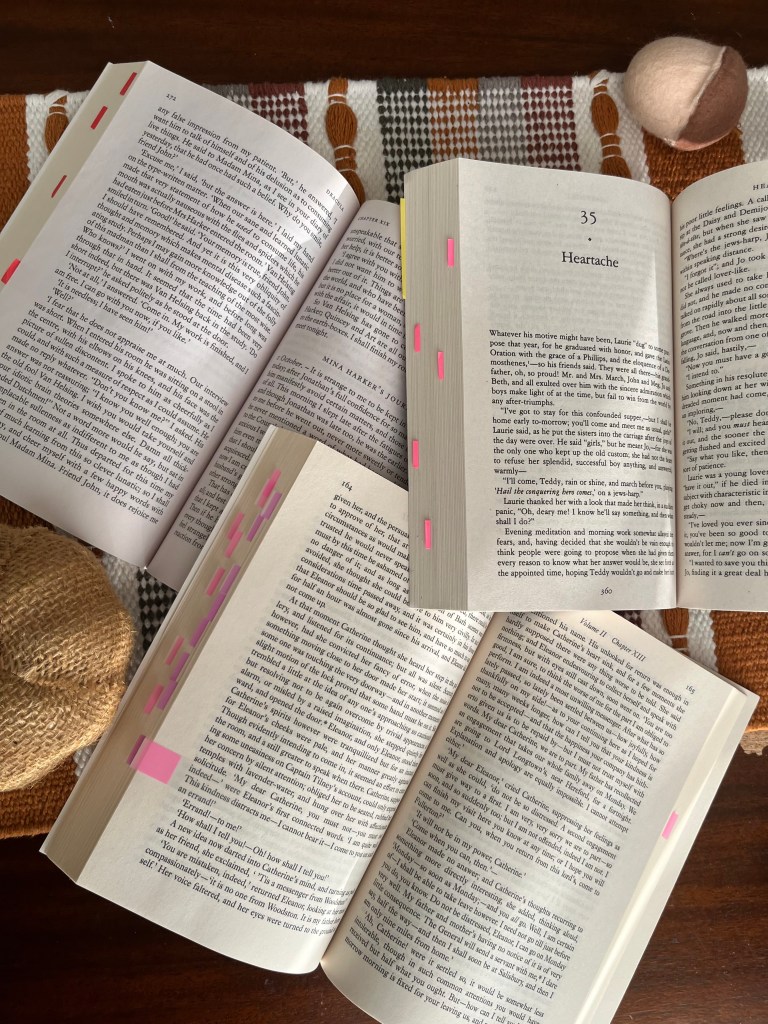
When you walk into a bookstore these days, the first thing you’ll see is a display (or three) with the word “Booktok” on it in large, bold print. These displays are colorful, eye-catching, and often right in the way so that you’re forced to either interact with the displays or shuffle past them as you eye the just as colorful titles that line the tables. This is all on purpose, of course. Since reading has been popularized again, largely thanks to the app TikTok, young women (and some men too) have curated a new, niche genre: Booktok books.
Last year, the Booksamillion I have frequented since I was a child closed their Joe Muggs cafe to make room for more displays. Gone were the cafe tables and espresso machines, welcomed were the shelves for the store’s three different sections of TikTok bestsellers. Each section has the giant label, and is indeed near the front of the store. As you browse, or attempt to checkout, it will surely catch your attention.
Thanks to the rise of these Booktok books, people’s tastes are being curated in an almost unprecedented way. If a couple people love a book (or are being bribed by publishers to say they love a book), they will then take to the internet to influence other to read that same book. And if you don’t love the book too, you are simply wrong. At least, this seems to be the way that the Booktok phenomenon works.
Tropes have become a necessary component to sell a book within this genre. If the book doesn’t fit into a certain trope, how else will the audience know they want to read it? Marketing now plays a huge role in the success of books; publishers send certain creators with notable platforms ARCs, or advanced reader copies, to gather interest and support around their upcoming releases. Those content creators are encouraged to say: “Yes, read this book. It’s amazing and just like the seven other books I reviewed last week.”
All this commotion gives reading as a hobby a different ambience. Pre “Booktok,” I hardly ever went into a bookstore knowing what I wanted to buy. I enjoyed being able to browse the shelves for a title or cover that caught my eye. There was a certain thrill in debating between two books and deciding which summary sounded more interesting. Those were the days of the bestselling The Hunger Games series and the wretched John Green novels.
I know what you’re thinking: Didn’t those books have tropes too? Of course they did, they were angsty, anti-capitalist novels essentially. And we loved them for it. The difference was that readers weren’t buying books based on tropes, and the writers weren’t writing around tropes. Readers bought books because maybe their trusted friend had a copy of the book on their desk at school, or their coworker let them borrow their copy to pass the time at work. Not because a 10 second video told them that they should.
Love it or hate it, the way that we buy books today has changed.
With the process of choosing books changing, what we consider to be “good” books has also changed. One can take a survey of a dozen women from ages 16 to 40, and at least one will respond with a title by the infamous romance writer Colleen Hoover (I once has this experience with not one, but two, of my middle-aged aunts). This may cause an internal (or external) cringe as you try to remain interested in the conversation.
There is a difference between titles by Colleen Hoover and titles by Jane Austen, that is something I think we can all agree on. Same genre, starkly different content. These Booktok books are pushing out what we consider to be classically “good” books, something that is impacting what the average reader looks like today.
════════════════════════════════════
Laura Thompson, a senior English Literature student, is not humored by the class discussion. She finds the abstract ideas too quirky, and the rabbit holes the professor trails down too meaningless. I know this because she cuts her eyes at me anytime he says something that goes over our heads. A skeptic of the postmodern, a nonbeliever of the weird, call it what you want, this is what Laura is. When she rolls her eyes and scoffs, this is her way of telling me that to her, the topic we’re discussing is meaningless.
She prefers definite meaning to what she reads; what’s the point of a novel if it’s ambiguously meaningless in the end?
Laura always carries her kindle around in her purse. Although she always has some sort of assigned reading to do as a literature student (romantic poetry, eighteenth century plays) she prefers her small, discreet device. She once told me that she likes having the freedom to read whatever she likes without fear of judgment from an academic. I almost reminded her that she is one of these academics, but I laughed instead.
With her circular glasses and her long, flowing skirts, Laura appears to be ready to discuss the Shelleys or Brontes at any moment. She carries her small purse with her everywhere she goes, always prepared for anything. Her long hair is usually done up in a braid or twist, further adding to her studious English Lit. major persona. Although the postmodern novel may not be her thing, Laura does adore classic works such as Kate Chopin’s “Desiree’s Baby,” and brings up Sylvia Plath’s The Bell Jar on a weekly basis.
As Laura and I browse Booksamillion (the one now devoid of its beloved Joe Muggs), she is struck by how much the store has changed since she last saw it a year ago. She is ensnared by the colorful Booktok displays as we chat about what she has read recently. Some displays even have tropes listed on the signs. While browsing the titles, we discuss the way she balances “reading for fun” and “reading real books.”
“If you read classics all the time, your brain is just gonna go dead, but if you read fantasy all the time, you’re never going to learn anything really, so its just for different purposes,” Laura observes thoughtfully.
Of course it’s okay to read fun books. Not everything we read has to be intellectually stimulating. Some books can just be cozy and comforting, others exciting and escapist. Whatever it is that makes reading fun isn’t wrong. However, if you have never read anything other than a “Booktok” book, you’ll never be intellectually stimulated in the way that “the classics” provide.
We spy a shelf full of Colleen Hoover titles, turning our conversation towards the way Hoover has given the romance genre a certain reputation. Romance makes up a large proportion of the Bookok genre. Laura thinks it’s not romance itself that is the cause for lackluster modern books of the genre, but the poor, cliche writing instead.
“Jane Austen could’ve been the Colleen Hoover of her time. But I feel like the substance of romance today, or of other books like that…there’s just no substance.” Laura mused as she brushed her fingers along the spine of a title. “Normally it’s full of cliches and there’s nothing original. Whereas someone like Jane Austen was different.”
Perhaps we should be sympathetic then, to these Booktok books. Any comparison to Austen will evoke that thought. But I can’t help considering the way that the books are already held to Austen status within the community, yet the content cannot compare to Pride and Prejudice or Persuasion. Austen’s work has survived this long as great for a reason, right? Will authors like Colleen Hoover knock her off her pedestal. This may be my greatest fear.
We especially get caught up in the classics section of the store, a small corner near the front, hidden just behind the Booktok displays, where we drool over the $12 special editions of Jane Eyre and Wuthering Heights.
Laura tells me that she collects first editions of classics. When we look up the value of the special editions, we find online prices to be over $150 per book. Shocked, we wondered why we were able to find them here, at a random Booksamillion for such cheap prices.
She takes a guess: “Maybe no one here wants them anymore.”
════════════════════════════════════
What I’m not saying is that we cannot enjoy fun books. In fact, I firmly believe we should. But we also shouldn’t let Booktok always tell us which books are worth our time. If we do, we’ll miss out on some of the great works that have been written and are still being written.
It is true that we all define good books as something different. But this is what keeps authors writing–everyone wants to tell stories that satisfy a part of them. We should read a balanced variety of books, as long as we’re out there searching for them, and not only being spoon-fed by publishers.
I have enjoyed books like Don DeLillo’s White Noise and I too bring up The Bell Jar on a weekly basis. But I also love a good Sarah J Maas book and I gave Twilight five stars upon my first read. What do all these books have in common?
Nothing, almost nothing at all. Except that I enjoyed them.

 flourishings.blog